

- Travel Safety App – Help You Home App & Emergency Wristband – Equipment Review - 10 August 2026
- Strangford Lough Islands Northern Ireland – Half-Day Itinerary - 30 March 2026
- Blend and Brew Portglenone Northern Ireland – Foodie Review - 9 February 2026
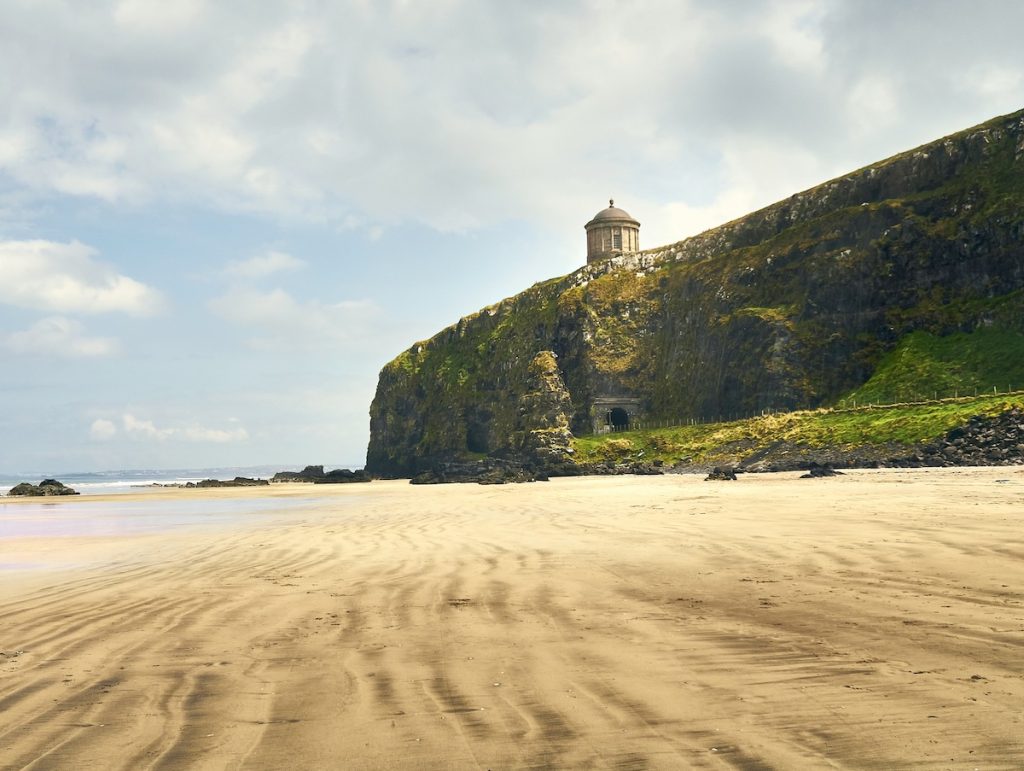
Mussenden Temple is perched on the cliff edge directly above Downhill Beach on Seacoast Road in Northern Ireland. It’s just up the road from Castlerock, a seaside resort just outside Coleraine. Crafted with local materials in a classical Graeco-Roman style, it is a double-height sandstone structure set on a basalt basement. Designed by well-travelled Irish architect Michael Shanahan, the folly was commissioned as a gift by the owner of Downhill Demesne, the Earl Bishop of Derry Frederick Hervey, for his beloved cousin, Mrs Frideswide Mussenden.
The National Trust’s Mussenden Temple and Downhill Demesne buildings were built between 1780-1799 by the English Earl Bishop of Derry, Frederick Hervey on an elevated cliffside site just off the Mussenden Road above Downhill Beach. It is known as an architectural “folly” – a term for a building erected purely for aesthetic, romantic, or whimsical reasons rather then purely functional ones and often in a classical style. Similar temples can be observed on other National Trust and private castles, stately homes, and mansions at other ‘big houses’ throughout Northern Ireland.
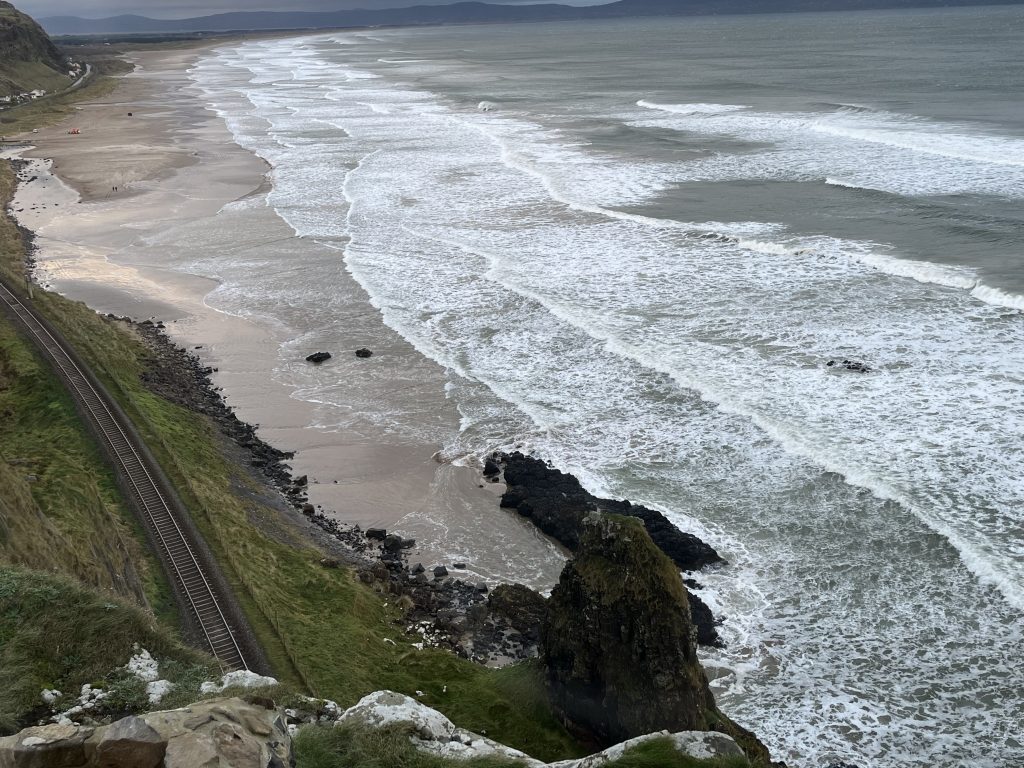
This image shows the cliff view from the Mussenden Temple down onto Downhill Beach.
Downhill Demesne is a sprawling estate that stretches from the Lion’s Gate entrance to the lower Bishop’s Gate and includes a series of other buildings, gardens, and places of interest:
- Downhill House – the ruins of the mansion house
- Mussenden Temple – the original library
- The Dovecote and The Icehouse – a building for birds on top of a food storage facility
- The Arboretum – a colletion of rare, non-native trees
- The Black Glen – a man-made lake for fishing
- Walled Garden
The bishop lived there until 1851 when a huge fire destroyed a large part of the building.
Royal Air Force Billet During Second World War
Downhill Demesne was used by the UK’s Royal Air Force during the Second World War.
Mussenden Temple Library
The temple was inspired by Bramante’s Tempietto in Rome, which was itself based on the Temple of Vesta at Tivoli near Rome. It is thought that the bishop had originally thought of transporting the original to Ireland – a true testament to his unlimited resources! (I wonder what the Italians might have thought of such a move.)
The temple was used as a library. Books were protected from the damp location by a permanent fire kept burning in the basement below.
It gets its name from Bishop Hervey’s cousin, Mrs Frideswide Mussenden, to whom it was dedicated.
Architectural Details
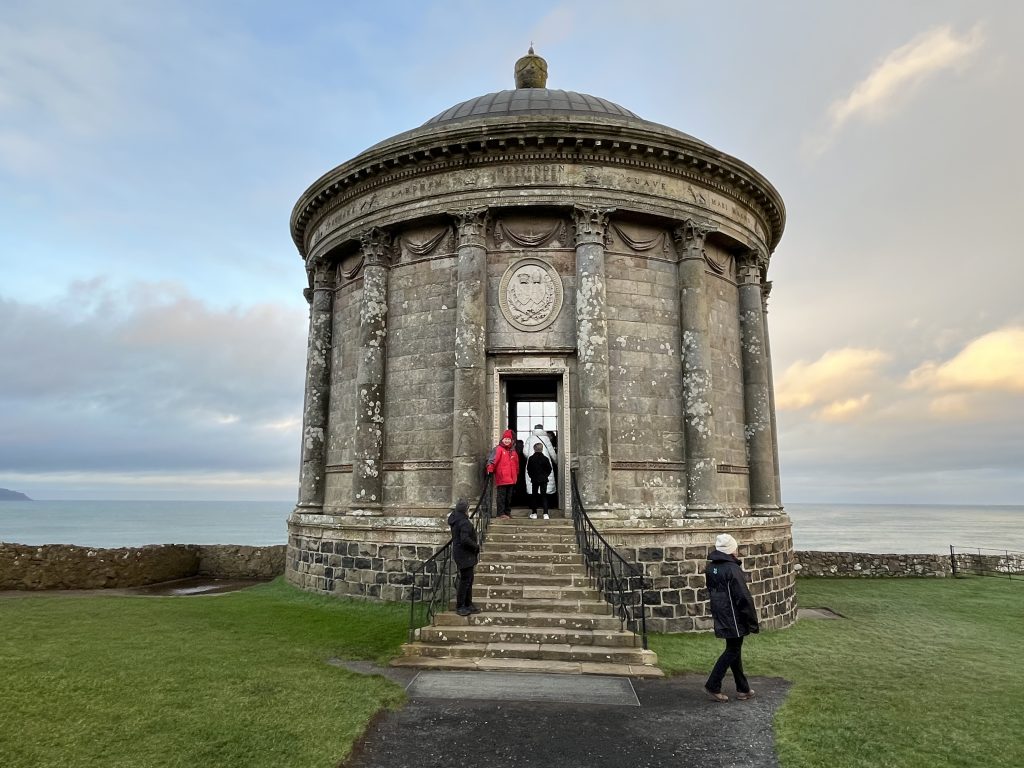
- Built in a classical Augustan style, the temple is a double-height construction built from local Bann brick and faced with Ballycastle sandstone
- Externally, sixteen engaged, sandstone Corinthian columns frame the windows with blind bays (spaces) between columns
- Each bay has a wave-scroll (similar to a Vitruvian one), a moulded plinth course, and a swagged panel between the capitals
- The columns work together to support a fluted architrave with a recognisable Greek key soffit, with bishop’s mitre and lion carvings decorating each capital
- The frieze is topped with a dentiled and modillioned cornice
- The columns sit on a sandstone base with fluted frieze which sits on a basalt base at the lower basement level
- The windows face north, east, and west
- The single entrance faces south and is surrounded with a decorative Portland stone architrave, fluted freeze and hood cornice
- It has a domed roof clad in copper
The Latin Inscription from Roman Philosopher Lucretius’s De Rerum Natura says:
‘”Suave, mari magno turbantibus aequora ventis e terra magnum alterius spectare laborem.” (“Tis pleasant, safely to behold from shore. The troubled sailor, and hear the tempests roar.”’)
Basement Place of Worship
The basement of the temple was given by the bishop to be used as a place of worship by Roman Catholic worshippers who worked as servants at the mansion house. The Earl Bishop had also been concerned to gain relief for Roman Catholics from some of the penal laws. And the basement was still in use into the nineteenth century.
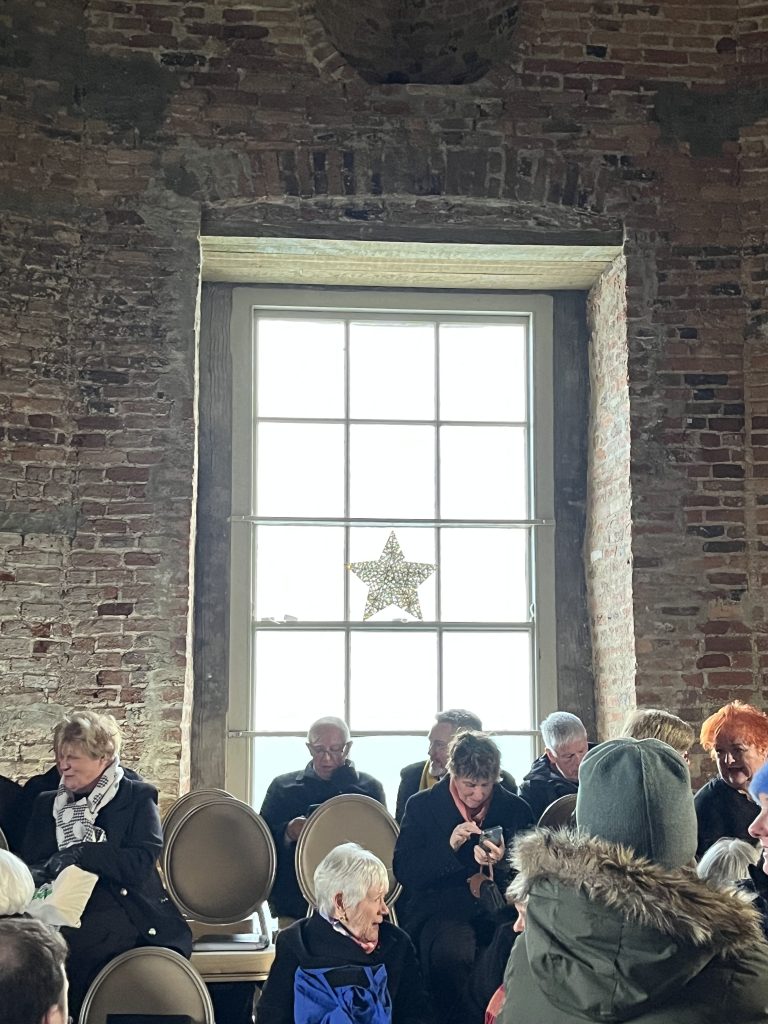
On the day we visited, we were in the main former library floor for a cheery Counterpoint Choir’s Christmas Carol Concert. It was a blustery, chilly day. But everyone was wrapped up warm, with blankets for extra cosiness. And, the National Trust had organised a shuttle bus to convey worshippers on a 2 minute ride from the car park to the temple.
National Trust Takeover
In 1946, Downhill Demesne was bought by FW Smyth who presented it to the National Trust as a gift in 1949.
The mansion house met its end in 1950 when the roof was removed to avoid tax, while land attached to the property was also sold. It was then purchased by the National Trust during the 1980s.
The roof of the temple has also been replaced several times, including by the National Trust.
Information About Mussenden Temple
Today, you can visit Downhill Demense and walk through the ruined mansion house, and visit the temple and other buildings, though the temple is not open except for occasional private events or weddings.
Find out more about Mussenden Temple on Seacoast Road Northern Ireland on the National Trust’s Mussenden Temple and Downhill Demesne page.

